This past week we were asked to take a trip down to our local archives and meet the archivist. The archivist here at Montevallo is a fun man named Carey Heatherly, and he was a huge help in finding what we needed for our assignment. My partner Mary Haynes and I, armed with our questions and notebook, were ready to do some digging.
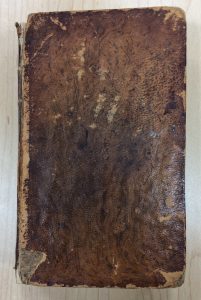
The first set of questions had to do with the oldest book in the archives. We ended up with a 1702 copy of The Satires of Decimus Junius Juvenalis, the 3rd edition with sculptures. This particular copy was printed by Jacob Tonson, an 18th century bookseller and publisher famous for buying the copyrights to William Shakespeare’s plays. We do not know exactly how it ended up in the United States, let alone in Alabama, but we did discover through the archive’s book logs that the College bought it for $6.50 on February 8,1952 form someone known only as “Elizabeth Bkseller”.
(Juvenal, Decimus. The Satires of Decimus Junius Juvenalis, 3rd ed. with sculptures. Jacob Tonson. Greys-Inn-Gate, London, 1702.)
The second Set of questions asked about a book with visible signs of wear and use. After searching for a bit, the best example we could find as a 1960 copy of The Mind of the South by W.J. Cash. This book had significant amount of both underlining and marginalia. With the help of the archivist we discovered that this book actually belonged to Ethel Rasmusson; Ethel was not only an avid donator to the archives, but also an instructor of history at the University of Montevallo. She received her master’s degree from the University of Chicago, and mainly taught History 101 and 102. Based on the areas underlined and the marginalia, we assume that this book as used to teach part of her class.
(Cash, W.J. The Mind of the South, 1st Vintage Ed. Vintage Books Inc. New York, 1960.)
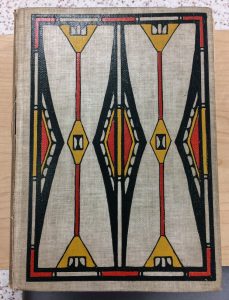
The final set of questions we were set out to discover involved a collection within the archives. When told this, the archivist pointed us towards the Library of Science collection. Identifiable by a stamp on the inside of the cover, this ongoing collection is made up of children’s books with vibrant drawings in them. Some of the books included are stories like Gulliver’s Travels by Swift, The Haunted Bookshelf by Morley, Merrylips by Dix, and many more. The cool part about this collection comes for the history of it. Mainly used during the 20’s and 30’s, these books were used in classrooms to show perspective teachers how to build a classroom library. We did some digging and actually found the course descriptions of the classes this collection was used in. Book Selection was the name of the class, under the code of LS (Library Science) 301/302; the class was taught by Greta Largo who was an assistant professor in Library Science. The significance of this collection stems from our area’s deep history in education for women because not only was it taught during the time of Alabama College for women but, also because Education was (and still is) the largest major on campus.
The first visit to the archives was a complete success, and I cannot wait to discover more and more as this course continues.
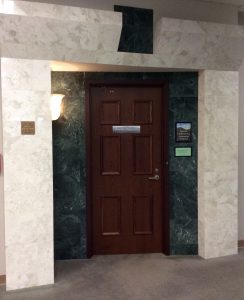 And then you get to the Special Collections door, shown here.
I (with Dakota) was able to meet with both of the librarians who work behind this strangely fancy door: Gene Hyde and Colin Reeve. They were both lovely, letting us handle the books as well as showing us how to navigate their database – and, of course, welcoming us back anytime (barring the fact that there’s a doorbell outside what I’ve come to call the Marble Gate).
There were a great number of books inside this room (many of them fairly recent, but I’ll touch on that later). There’s room for error, since both Gene and Colin admitted that their database was acting up, but out of this mass of caged books we were able to draw out a strong contender for Oldest Book In Room: A priest to the temple. Or, The country parson his character, and Rule of Holy Life. This book, written by George Herbert and published in 1675, bears clear signs of being passed from hand to hand over the centuries, as indicated by the title page.
This book was rebound on November 26, 1913, as stated by a note scrawled before the title page, but still retains its original pages. It’s just not, you know, falling apart. Before the title page, there are a number of notes with varying degrees of legibility stating who the
And then you get to the Special Collections door, shown here.
I (with Dakota) was able to meet with both of the librarians who work behind this strangely fancy door: Gene Hyde and Colin Reeve. They were both lovely, letting us handle the books as well as showing us how to navigate their database – and, of course, welcoming us back anytime (barring the fact that there’s a doorbell outside what I’ve come to call the Marble Gate).
There were a great number of books inside this room (many of them fairly recent, but I’ll touch on that later). There’s room for error, since both Gene and Colin admitted that their database was acting up, but out of this mass of caged books we were able to draw out a strong contender for Oldest Book In Room: A priest to the temple. Or, The country parson his character, and Rule of Holy Life. This book, written by George Herbert and published in 1675, bears clear signs of being passed from hand to hand over the centuries, as indicated by the title page.
This book was rebound on November 26, 1913, as stated by a note scrawled before the title page, but still retains its original pages. It’s just not, you know, falling apart. Before the title page, there are a number of notes with varying degrees of legibility stating who the 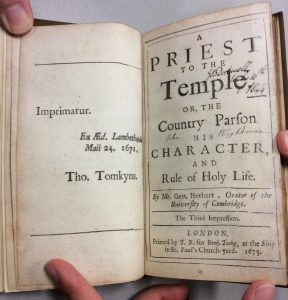 book belonged to, and in some cases under what circumstances.
The earliest entry we found during a cursory inspection was from 1727; it was mostly illegible to me, having been written in script with now-fading ink and all, but we did determine that it belonged to someone named Wells. I think I could pick out a few other random words, such as “Wightman,” “Bosford,” and “Roe.” I don’t know if these are names or places, since they were all written by the same hand and aren’t all formatted the same way. The next dated entry (that we could find) was from July 1, 1878, when this book was given as a “birth day greeting” to a S. Howard Hall. “Soon” after that, the book was rebound as I said by someone with the initials S. H. H. After that, it gets a little fuzzy date-wise. There are pencil marks on the initial pages, seeming to indicate ownership by a library prior to that of UNC Asheville (and relatively recently, at that) and even a price: $220. Gene and Colin mentioned that this book was purchased from a book dealer at some point, but I’m not sure when this happened in relation to said library.
This book kind of doubles as an answer to the first two questions of our assignment (the oldest book and a book that bears evidence of reader use) so I’m going to touch a bit more on this one but briefly throw in another book as a sort of safety net. Clearly, the past owners of this book wanted to stake their claim upon the pages and were not afraid to write in it, but the pages themselves are largely intact. Given that the subject matter isn’t something simple, and also that it covers a largely religious subject in a time where religion was a key part of life (even more so than today in ways), I think it’s safe to say that the owners of this book were purposely very careful to conserve it. Perhaps it held some sort of meaning for them, which might be how it arrived with its pages not crumbling or even dogeared. This stands in stark contrast to another book of which I regrettably didn’t take a picture. Though published later than Herbert’s, this book (something beginning with The pilgrim’s progress, though I didn’t catch the rest) was c
book belonged to, and in some cases under what circumstances.
The earliest entry we found during a cursory inspection was from 1727; it was mostly illegible to me, having been written in script with now-fading ink and all, but we did determine that it belonged to someone named Wells. I think I could pick out a few other random words, such as “Wightman,” “Bosford,” and “Roe.” I don’t know if these are names or places, since they were all written by the same hand and aren’t all formatted the same way. The next dated entry (that we could find) was from July 1, 1878, when this book was given as a “birth day greeting” to a S. Howard Hall. “Soon” after that, the book was rebound as I said by someone with the initials S. H. H. After that, it gets a little fuzzy date-wise. There are pencil marks on the initial pages, seeming to indicate ownership by a library prior to that of UNC Asheville (and relatively recently, at that) and even a price: $220. Gene and Colin mentioned that this book was purchased from a book dealer at some point, but I’m not sure when this happened in relation to said library.
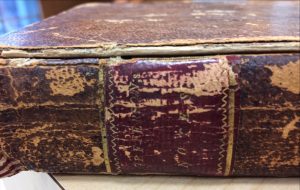
This book kind of doubles as an answer to the first two questions of our assignment (the oldest book and a book that bears evidence of reader use) so I’m going to touch a bit more on this one but briefly throw in another book as a sort of safety net. Clearly, the past owners of this book wanted to stake their claim upon the pages and were not afraid to write in it, but the pages themselves are largely intact. Given that the subject matter isn’t something simple, and also that it covers a largely religious subject in a time where religion was a key part of life (even more so than today in ways), I think it’s safe to say that the owners of this book were purposely very careful to conserve it. Perhaps it held some sort of meaning for them, which might be how it arrived with its pages not crumbling or even dogeared. This stands in stark contrast to another book of which I regrettably didn’t take a picture. Though published later than Herbert’s, this book (something beginning with The pilgrim’s progress, though I didn’t catch the rest) was c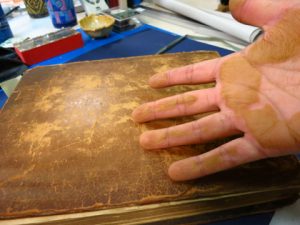 rumbling so badly that it had to be kept in an envelope. The original leather binding had a severe case of redrot, to the point where half of it had fallen off entirely, and the pages themselves had separated in the middle of the binding. (The picture here is not of the book in question; it’s just an example of redrot I found. The actual book was in way worse condition.) I know Herbert’s book was rebound so it’s not really a fair comparison, but the pages (which were intact in both books) showed a clear difference nonetheless. I’d hazard a guess that either the owners of Herbert’s book valued it more than the owners of the other book valued theirs, or the latter book just passed through way more hands. Or both.
The most notable collection in that room, though, wasn’t nearly so old. And it’s a cookbook collection, of all things: The Pamela C. Allison Cookbook Collection, spanning from 1932 to 2015. Gene and Colin had a great time describing their adventure to Pamela’s house to retrieve the cookbooks; there were around 3000 of them just piled around this woman’s house. They only took 1000 or so (those that ascribed to the common theme of Southern cooking) but those fill up two large bookshelves in the Special Collections room and are continuing to expand. In a statement available on the UNC Asheville Special Collections website, Pamela herself wrote “My cookbook collection is rooted in three seemingly unrelated interests—good food, reading, and research.” She combined her childhood love of her grandmother’s cooking with her desire to broaden her reading sphere, and started amassing cookbooks until it became an obsession. One of the professors here, Dr. Erica Abrams Locklear, was teaching a class that explored culture through cookbook literature, which motivated Pamela to donate her collection for the good of the Asheville community. She’s still collecting today.
Near the end of our meeting, the discussion turned to the librarians’ most valuable commodities. Though we did discuss the value of a book or two, they made clear that their collection wasn’t based on value. Half-jokingly, they told us that their most valuable commodity was space, and they were running out of it fast. It’s pretty clear just by looking around the room; all of the protective bookshelves were almost entirely full, and the normal bookshelves housing the cookbook collection were almost sagging under the weight of the number of books crammed into it. There’s so much crammed into each book, too; look how long I spent rambling about one or two books in this post, not even delving into content. I hope they can figure out plans for either increased storage or expansion; it won’t be good when we run out of room for this kind of knowledge.
rumbling so badly that it had to be kept in an envelope. The original leather binding had a severe case of redrot, to the point where half of it had fallen off entirely, and the pages themselves had separated in the middle of the binding. (The picture here is not of the book in question; it’s just an example of redrot I found. The actual book was in way worse condition.) I know Herbert’s book was rebound so it’s not really a fair comparison, but the pages (which were intact in both books) showed a clear difference nonetheless. I’d hazard a guess that either the owners of Herbert’s book valued it more than the owners of the other book valued theirs, or the latter book just passed through way more hands. Or both.
The most notable collection in that room, though, wasn’t nearly so old. And it’s a cookbook collection, of all things: The Pamela C. Allison Cookbook Collection, spanning from 1932 to 2015. Gene and Colin had a great time describing their adventure to Pamela’s house to retrieve the cookbooks; there were around 3000 of them just piled around this woman’s house. They only took 1000 or so (those that ascribed to the common theme of Southern cooking) but those fill up two large bookshelves in the Special Collections room and are continuing to expand. In a statement available on the UNC Asheville Special Collections website, Pamela herself wrote “My cookbook collection is rooted in three seemingly unrelated interests—good food, reading, and research.” She combined her childhood love of her grandmother’s cooking with her desire to broaden her reading sphere, and started amassing cookbooks until it became an obsession. One of the professors here, Dr. Erica Abrams Locklear, was teaching a class that explored culture through cookbook literature, which motivated Pamela to donate her collection for the good of the Asheville community. She’s still collecting today.
Near the end of our meeting, the discussion turned to the librarians’ most valuable commodities. Though we did discuss the value of a book or two, they made clear that their collection wasn’t based on value. Half-jokingly, they told us that their most valuable commodity was space, and they were running out of it fast. It’s pretty clear just by looking around the room; all of the protective bookshelves were almost entirely full, and the normal bookshelves housing the cookbook collection were almost sagging under the weight of the number of books crammed into it. There’s so much crammed into each book, too; look how long I spent rambling about one or two books in this post, not even delving into content. I hope they can figure out plans for either increased storage or expansion; it won’t be good when we run out of room for this kind of knowledge.